
We Don’t Treat Diseases. We Treat the Body’s Response.
Modern medicine has given us increasingly sophisticated ways to identify diseases. We can classify, label, and diagnose conditions with remarkable precision. Yet in daily clinical practice, an important question often remains unanswered:
Why do two people with the same diagnosis recover so differently?
One patient improves rapidly, while another continues to struggle despite receiving what appears to be the same treatment.
At YOON CLINIC, this question has fundamentally shaped the way we think about medicine.
The Cause Is Only the Beginning
Finding the cause of a disease matters.
However, the cause is not always the most useful therapeutic target.
The same viral infection, psychological stress, or physical injury can produce remarkably different responses in different individuals.
One person develops severe pain.
Another develops insomnia.
Another experiences digestive dysfunction.
Someone else recovers with minimal symptoms.
The difference often lies not in the original trigger, but in how the body responds to it.
Instead of asking only, “What caused this disease?”, we also ask, “How is this patient’s body responding?”
Symptoms Are Not the Disease
Symptoms are not random events. They represent the body’s attempt to adapt to a physiological disturbance.
Rather than viewing symptoms as isolated problems, we see them as clues that reveal changes occurring beneath the surface.
Our clinical reasoning follows a different sequence:
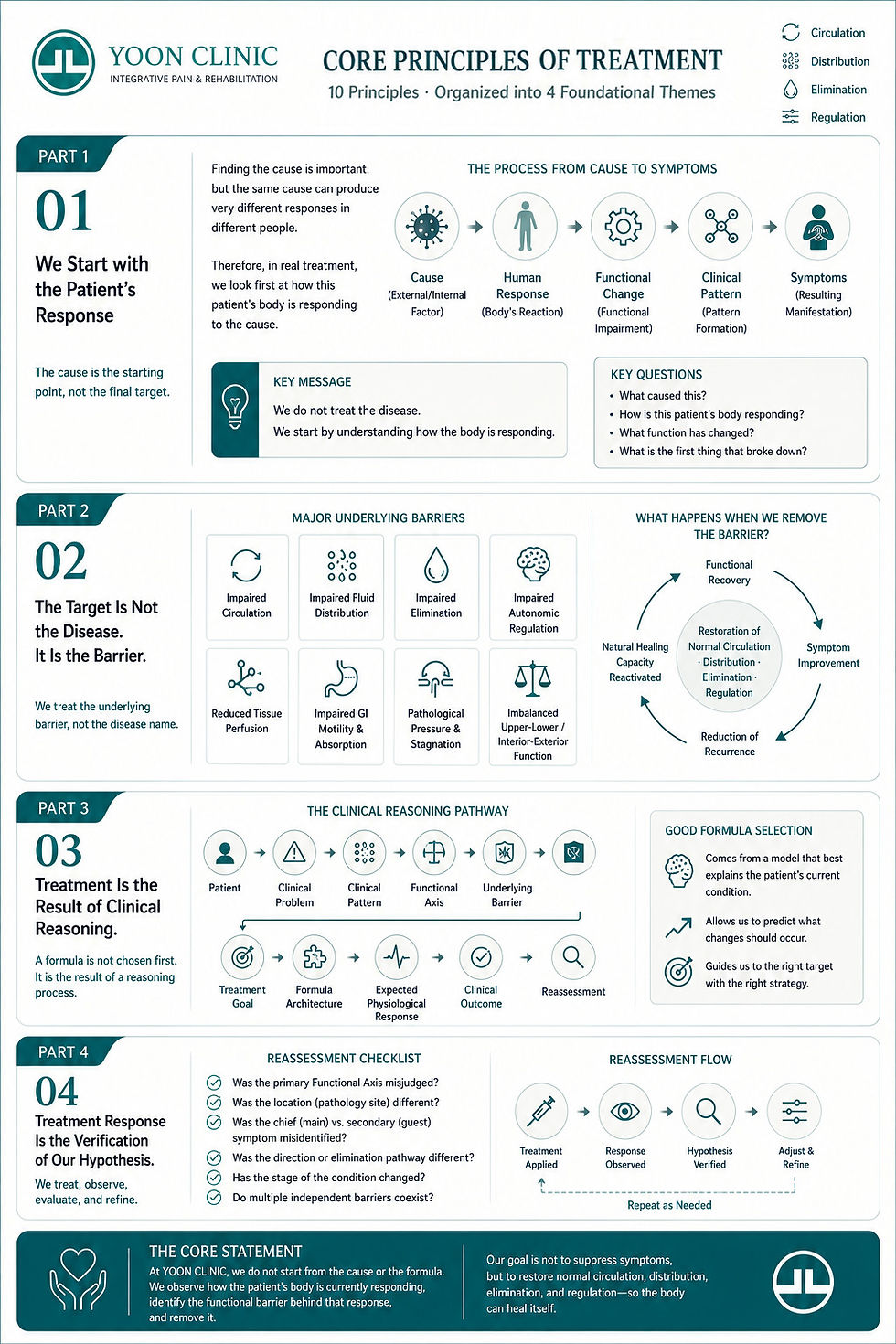
Cause → Human Response → Functional Change → Clinical Pattern → Symptoms
Understanding this sequence allows us to move beyond simply naming a disease and begin understanding the patient’s current physiology.
The Real Target: The Underlying Barrier
At YOON CLINIC, our goal is not simply to suppress symptoms. We aim to identify the Underlying Barrier that prevents the body from returning to normal function.
These barriers may include:
Impaired circulation
Abnormal fluid distribution
Reduced elimination
Autonomic dysregulation
Decreased tissue perfusion
Gastrointestinal dysfunction
Pathological pressure and stagnation
Imbalance between upper and lower, interior and exterior physiological function
Although two patients may share the same diagnosis, the barriers preventing recovery can be entirely different.
Treating the diagnosis alone may not restore normal physiology. Removing the barrier often can.
Clinical Patterns Matter More Than Labels
Traditional East Asian medicine introduced the concept of 證 (Pattern).
At YOON CLINIC, we understand a clinical pattern not as a list of symptoms, but as the functional architecture of the illness.
A clinical pattern answers questions such as:
Where is the primary dysfunction?
How is it progressing?
Which symptoms are primary?
Which symptoms are secondary consequences?
How are different findings connected?
A diagnosis tells us what the disease is. A clinical pattern helps explain why this particular patient looks the way they do today.
Treatment Is the Result of Clinical Reasoning
We do not begin with a formula. We begin with the patient.
Our reasoning process follows a consistent framework:
Patient → Clinical Problem → Clinical Pattern → Functional Axis → Underlying Barrier → Treatment Goal → Therapeutic Strategy → Expected Physiological Response → Clinical Outcome → Reassessment
Treatment should emerge naturally from this reasoning process. It should never precede it.
The Body Heals. Our Role Is to Remove Barriers.
One of the core philosophies of YOON CLINIC is simple: The human body is inherently designed to heal.
Healing is not something clinicians create. Our responsibility is to remove the obstacles preventing normal physiological regulation.
When circulation improves…
When fluid distribution normalizes…
When autonomic regulation stabilizes…
When tissues regain normal perfusion…
...the body’s own healing mechanisms often become active once again.
Every Treatment Is Also a Test
Treatment is never the end of clinical reasoning. It is part of the reasoning process itself.
Each clinical response helps answer important questions:
Was the primary barrier correctly identified?
Was the functional axis accurately understood?
Have the main symptoms improved while secondary symptoms changed as expected?
Does the original hypothesis still explain the patient’s condition?
Every response refines our understanding of the patient.
Our Philosophy
At YOON CLINIC, we do not begin with the disease. We do not begin with the formula. We begin with the patient.
By understanding how the body is responding, identifying the underlying functional barrier, and restoring normal physiological regulation, our goal is not simply to reduce symptoms—but to create the conditions in which the body can heal itself.
“Medicine is not the art of matching diseases with treatments. It is the art of understanding how each individual body responds and helping it recover.”


Comments